Democracy for Sale: Fixing America’s Money-Driven Campaign System 💰🇺🇸
America’s campaign system is distorted by massive private money, largely unleashed by decisions like Citizens United v. Federal Election Commission, which allows unlimited outside spending that pushes politicians to rely on wealthy donors and Super PACs. A realistic fix would combine public financing of campaigns, strict donor transparency, stronger limits on outside spending (possibly through a constitutional amendment), and incentives that amplify small donations so ordinary voters—not billionaires—become the main financial force in elections.
3/14/20262 min read
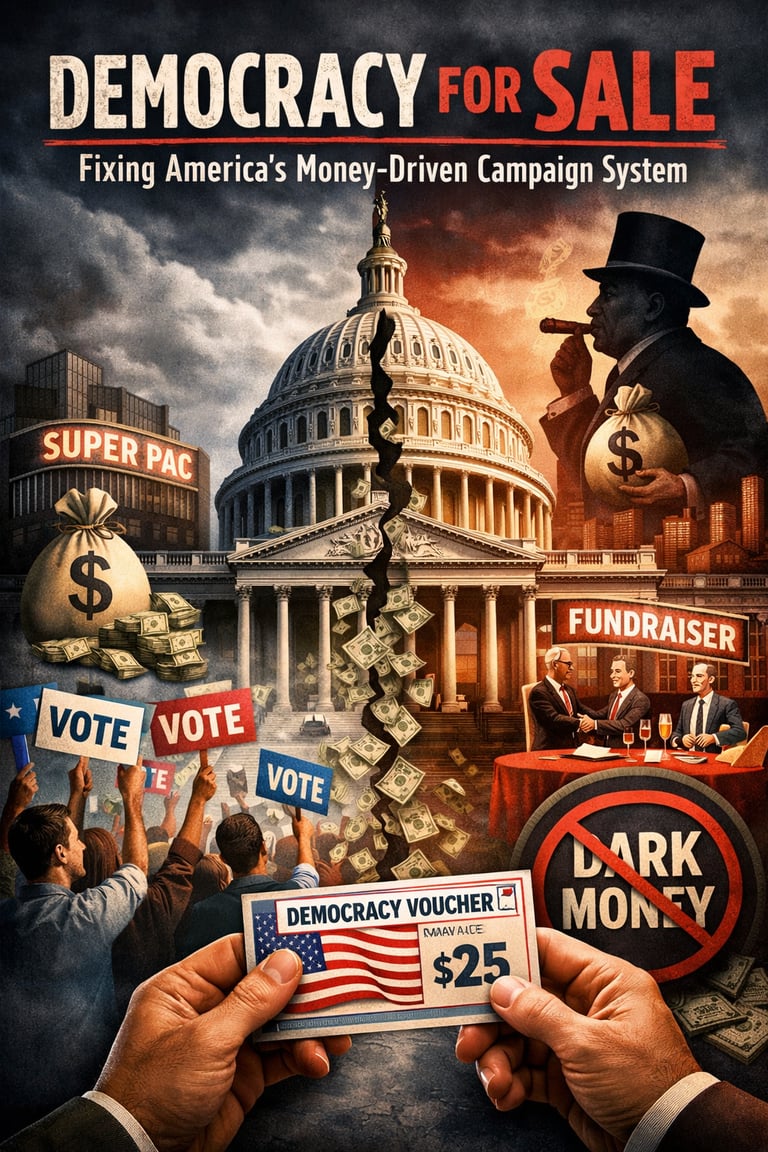
Money in American politics is like gravity in physics….invisible most of the time, but absolutely shaping everything. 🧠 Once it gets strong enough, it bends the entire landscape.
The modern campaign system really started mutating after a couple of Supreme Court rulings. The big one was the 2010 decision in Citizens United v. Federal Election Commission. That ruling said corporations and outside groups could spend unlimited money on political messaging as long as it wasn’t “coordinated” directly with campaigns. The theoretical idea was free speech. The practical result was a flood of Super PACs and dark-money groups that can raise and spend tens or hundreds of millions.
Today a competitive Senate race can cost $50–200 million, and the 2024 federal election cycle cost over $15 billion across presidential, congressional, and outside groups. At that scale, politicians spend enormous amounts of time dialing donors instead of solving problems. The system slowly becomes a donor-attention economy.
Fixing it is actually not a mystery. Political scientists have been proposing the same handful of solutions for decades. The difficulty is that the people who benefit from the current system are the ones who would have to change it. A neat little democratic paradox.
First big lever….public campaign financing. Instead of relying on wealthy donors, campaigns receive public funds if they meet small-donor thresholds. Several cities and states already experiment with this. For example, New York City gives a 6-to-1 match on small donations, meaning a $50 donation becomes $350. That shifts candidates toward ordinary voters instead of mega-donors.
Second….strict transparency. A lot of money in politics now flows through nonprofit shells where donors remain hidden. Economists and reformers across the spectrum argue that any organization spending serious money on elections should have to disclose who paid for it. Sunlight isn’t perfect, but it at least lets voters see who is buying the megaphone.
Third….limit outside spending through constitutional change. Because of Citizens United and later cases like McCutcheon v. Federal Election Commission, Congress has limited authority to cap political spending. Some reformers argue the only long-term fix is a constitutional amendment clarifying that campaign spending can be regulated.
Fourth….shorter campaign seasons. The United States runs essentially permanent campaigns that last two years. In many democracies campaigns are legally limited to a few weeks. When the race is shorter, the cost drops dramatically.
Fifth….small-donor incentives. Tax credits or democracy vouchers can give every citizen a small publicly funded amount to donate to candidates. Seattle tried this with $25 “democracy vouchers.” Suddenly ordinary voters—not billionaires—become the largest funding pool.
Here’s the strange thing about American democracy: the founders actually feared concentrated political money. James Madison warned that factions with wealth could dominate politics if institutions didn’t balance them. Two centuries later we are still trying to engineer those counterweights.
The good news is the system isn’t physically broken—it’s structurally tilted. Tilt can be corrected if enough voters demand it. History shows reforms tend to happen in waves: the Progressive Era reforms in the early 1900s, the post-Watergate reforms in the 1970s, and potentially another wave whenever public pressure reaches escape velocity.
Democracy is a bit like a garden….if you stop tending it, the weeds don’t politely wait their turn. 🌱.