Diplomacy Died — And the Region Is Burning
Seventy-two hours into the conflict with Iran, the reality on the ground looks nothing like the clean, controlled war presented in Hegsteth's ramblings. What began as an air campaign is rapidly evolving into a dangerous regional trap —one designed to drain U.S. resources, destabilize the Gulf, and escalate the conflict far beyond its original scope.
3/6/20263 min read
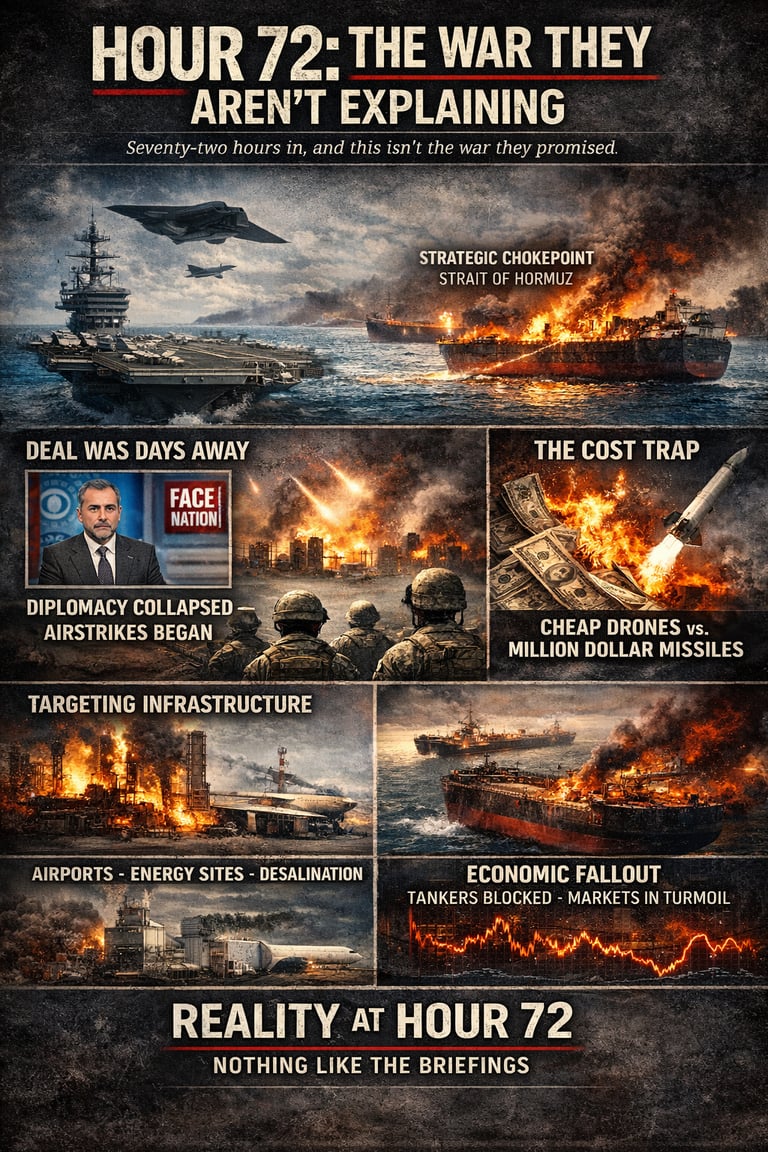
72 hours: THE WAR THEY AREN’T EXPLAINING
Television is showing clean missile footage and words like “precision strikes.” Reality looks very different. Seventy-two hours in, this isn’t shaping up as a quick military victory. It’s turning into a strategic trap — financial, regional, and political — and the United States is walking straight into it.
The strangest part is what happened before the bombs even fell.
On February 27, 2026, Oman’s Foreign Minister Badr Al-Busaidi went on Face the Nation and described a nuclear agreement Iran had just accepted in Geneva. Iran reportedly agreed to zero stockpiles of enriched uranium, full access for international inspectors, and permanent downgrades of its nuclear material. Diplomats were already scheduling the next technical talks in Vienna. By most accounts, the framework for a deal was days away.
Hours later the air campaign began.
No congressional address. No detailed intelligence briefing. The explanation for war — Iran refusing nuclear limits — was collapsing at the very moment the missiles launched. While diplomats were negotiating in Geneva, U.S. carrier groups were already moving toward the region. Tehran knew it. Iranian leaders publicly warned that even assassinating their leadership would not collapse the state.
That context explains Iran’s response today.
They are not behaving like a country expecting negotiations. They are behaving like a regime that believes surrender leads only to destruction.
THE WAR SOMEONE PREDICTED
Two years earlier, a historian named Jiang Xueqin predicted almost this exact scenario. In a little-noticed 2024 lecture titled “Why America Will Invade Iran and Lose,” he argued that Iran would not try to defeat the United States directly. Instead it would try to trap it.
His reasoning was simple game theory. Iran’s strategy would be to absorb early damage, activate regional proxies, and stretch the conflict long enough that the economic and political cost becomes unbearable for Washington.
Iran doesn’t need to win battles.
It only needs the United States to stay long enough that staying becomes impossible.
THE COST TRAP
The numbers already hint at the imbalance.
Iran is launching low-cost drones reportedly costing around $35,000 each.
Intercepting them often requires missiles costing millions of dollars per shot.
In the opening days of the conflict:
Hundreds of cruise missiles were launched.
Stealth bombers began round-the-clock missions costing hundreds of thousands per flight hour.
Carrier groups in the region cost millions daily just to operate.
The financial equation is brutally simple: Iran spends thousands; the United States spends billions.
THE INFRASTRUCTURE STRATEGY
Iran’s targets reveal the deeper strategy.
Airports.
Energy terminals.
Shipping routes.
And potentially next — desalination plants.
Much of the Gulf region relies on desalination facilities for fresh water. Knocking them out could trigger mass humanitarian crises and force outside powers to intervene on the ground to stabilize the region.
That possibility is exactly what many analysts fear Iran wants: a war that drags foreign troops onto land.
THE ENERGY CHOKEPOINT
Then there is the Strait of Hormuz.
About 30% of the world’s traded oil moves through that narrow passage. Within days of the conflict escalating, tanker traffic reportedly dropped sharply as ships hesitated to pass through the danger zone. Insurance costs skyrocketed. Tankers began waiting outside the strait.
If that chokepoint fully closes, the shock wouldn’t just hit energy markets. It would ripple through inflation, global trade, and already fragile economies.
THE REALITY AT HOUR 72
Seventy-two hours into the conflict, the picture looks nothing like the polished briefings on television.
A diplomatic deal was reportedly close days before the war began.
Iran is responding not like a government seeking talks, but like one determined to make the conflict as costly as possible.
Regional infrastructure is increasingly in the crosshairs.
And the economic stakes stretch far beyond the battlefield.
Wars rarely unfold the way they are advertised in the opening days. History is littered with leaders who believed a conflict would be quick, controlled, and decisive — right up until it wasn’t.
The strange truth about war is that it often starts with speeches about strength and ends with accountants calculating the damage. And right now, the math is only beginning.