JUSTICE Withheld Docs Related to TRUMP CHILD RAPE
An NPR investigation found that the Justice Department appears to have withheld and removed certain Epstein-related files that reference allegations involving President Trump, despite records suggesting the documents exist in FBI logs. The DOJ says any missing materials are privileged, duplicative, or tied to ongoing investigations, while congressional Democrats are launching a probe into whether records were improperly withheld.
2/25/20262 min read
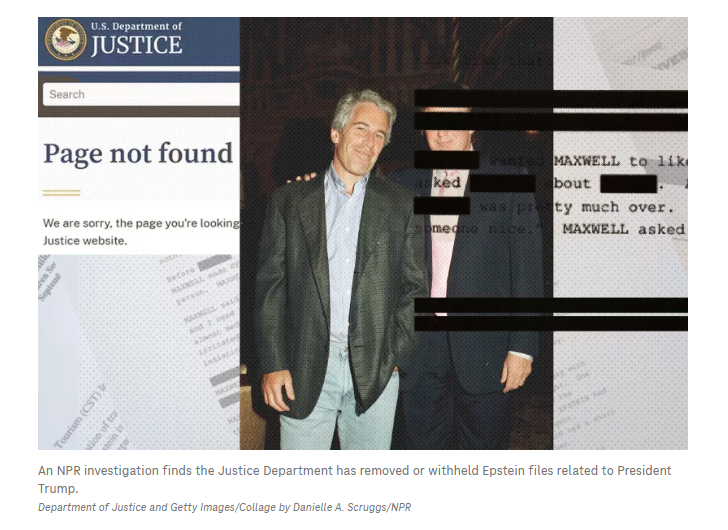
An NPR investigation reports that the Justice Department withheld and removed certain Epstein-related files that include allegations involving President Trump. According to their review, some documents that appear in official FBI and DOJ logs were never made public, even though federal law requires a broad release of the Epstein files. NPR compared serial numbers stamped on FBI case records, internal emails, and discovery logs tied to the Maxwell prosecution and found gaps in the publicly available database.
Specifically, they identified more than 50 pages of FBI interview materials that appear to exist but are not currently accessible to the public. Those include multiple interviews with a woman who alleged that Trump sexually abused her decades ago when she was a minor. Only one of her four FBI interviews is publicly available, and that version does not mention Trump. The additional interviews, along with accompanying notes, are referenced in case logs but are missing from the DOJ’s online archive.
The Justice Department declined to answer detailed on-the-record questions about the specific files NPR asked about. After publication, the department reiterated its general position that any documents not released are either privileged, duplicates, improperly uploaded, or connected to ongoing investigations. DOJ officials also stated that no records were withheld for reasons of political embarrassment or reputational harm.
Democrats on the House Oversight Committee say they reviewed unredacted evidence logs and believe the department may have improperly withheld certain FBI interview materials. They have announced a parallel investigation focused specifically on the DOJ’s handling of the file release process. Republican leadership has not indicated plans for a similar inquiry at this time.
Some files that were initially removed have since been reposted. Others remain offline. The DOJ has acknowledged that thousands of pages were taken down and reuploaded in recent weeks to correct redaction errors involving victim names and personally identifiable information. Officials say they are working to balance transparency with privacy protections for abuse survivors.
The White House responded by stating that President Trump has been fully exonerated in matters related to Epstein and that the administration has released thousands of pages, cooperated with congressional subpoenas, and supported transparency legislation. The White House also maintains that some allegations contained in the broader Epstein files are unverified and sensational.
Attorneys for one of the women involved criticized the Justice Department’s rollout of the documents, arguing that the release process has been chaotic and has at times exposed victims’ information while still leaving key materials unavailable. They say the department had one job, which was to release records in a transparent and responsible way.
At the heart of this situation is a basic issue of trust. When a database shows document serial numbers that suggest materials exist but are not publicly available, people will want clear explanations. If documents are withheld for legitimate legal, privacy, or investigative reasons, that reasoning needs to be specific and documented. In cases this politically charged, even small inconsistencies quickly become fuel for suspicion. Transparency is not optional in moments like this. It is the only way credibility survives.