This Part of TRUMP's Nation Breaking Tariffs Will NOT Go Away!
Tariffs put in place by President Donald Trump on key building materials are still sticking around, even after the Supreme Court weighed in on broader trade questions. HOUSING COSTS WILL NOT DROP!! The damage is done!
2/20/20262 min read
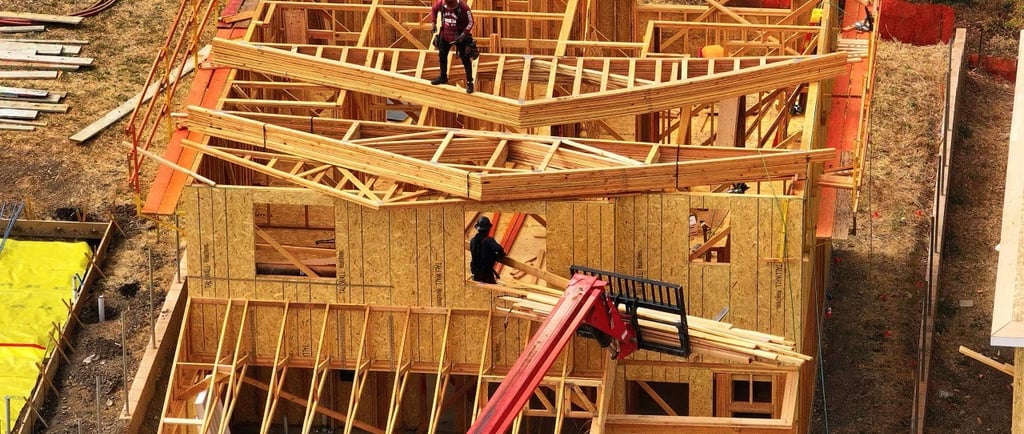
At a moment when the United States is already short by millions of housing units, construction just got more expensive. Tariffs put in place by President Donald Trump on key building materials are still sticking around, even after the Supreme Court weighed in on broader trade questions. The reason is technical but important: these tariffs were imposed under separate statutes tied to “national security” and “unfair trade practices.” In other words, they’re legally insulated. Different legal lever… same price tag at the lumber yard.
Here’s where economics stops being abstract and starts showing up in someone’s mortgage payment. Materials like lumber, steel, and aluminum are not boutique add-ons. They’re the skeleton and skin of a house. When you tax those inputs, you raise the baseline cost of construction. The National Association of Home Builders estimates that current tariffs add roughly $10,900 to the cost of building an average new home. That isn’t theory. That’s math flowing straight into listing prices.
Bill Owens, the NAHB chairman, responded bluntly. In a country already wrestling with an affordability crisis, he argued that tariffs on building materials increase costs, disrupt supply chains, and create pricing uncertainty for builders. Uncertainty is poison for housing markets. Builders price risk into homes. Lenders price risk into loans. Buyers either pay more or walk away.
Now let’s be intellectually honest. Tariffs are sometimes used as leverage. They can protect domestic industries or pressure foreign competitors accused of dumping goods below market value. In theory, that can strengthen domestic production. In practice, when domestic supply cannot scale fast enough to meet demand, tariffs function like a consumption tax on Americans trying to build or buy homes.
The U.S. housing shortage is estimated in the millions. Basic supply-and-demand logic applies. Constrain supply further by raising input costs, and prices rise. That is not partisan. That is Econ 101 with a hard hat on 🧱.
The strange irony is that housing affordability is one of the few issues that unites urban progressives and rural conservatives. Everyone wants their kids to be able to buy a home. Policy tools matter. Trade policy, industrial policy, and housing policy are all interconnected, whether politicians like admitting it or not.
The broader question isn’t whether tariffs are inherently evil or virtuous. It’s whether they are calibrated to solve one problem without worsening another. When the country is short millions of homes, adding nearly $11,000 per unit deserves scrutiny, not slogans.
Housing markets are ecosystems. Tug one lever in trade law, and a first-time buyer in Ohio feels it. Economics has a long memory and very little patience for magical thinking.