
War by Gut Feeling: When “I’ve Got This” Meets Reality 😏
If you ever wanted a real-time demonstration of what happens when confidence replaces competence… here it is. Watching this unfold feels less like strategic leadership and more like a guy confidently guessing on a test he never studied for 😏
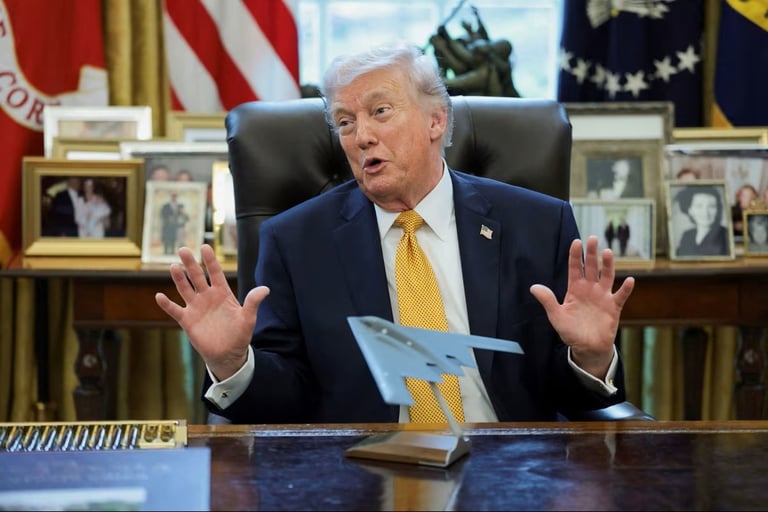
However one feels about the strategic and moral wisdom of the Iran war, it’s indisputable that President Donald Trump’s commentary on it has been confusing, inconsistent and contradictory. It often looks a lot like the man leading the war effort isn’t terribly clued in on or curious about the details.
Monday, more than any day so far, epitomized this.
Across a pair of public appearances, Trump assured that he didn’t need advisers to help him make decisions. Then he cast a widely anticipated Iranian response of attacking its Gulf neighbors — something those advisers surely would have told him about — as something that nobody could possibly have anticipated.
And Trump didn’t just say this once. He’s now said it repeatedly, in rather bizarre fashion, which is raising more questions about whether the man who just launched a war in the Middle East truly understood the implications of what he was undertaking.
Trump says he doesn’t need advisers
At a meeting with the Kennedy Center board at the White House, Trump was asked whether his advisers had told him how long gas prices will remain elevated.
“I don’t need advisers to tell me that; I know what it is,” the president said.
Then, while calling on allies to help secure the Strait of Hormuz, Trump took a shot at British Prime Minister Keir Starmer for wanting to deliberate with his team.
“You know, the prime minister of the UK, United Kingdom, yesterday told me, ‘I’m meeting with my team to make a determination.’ I said, ‘You don’t need to meet with the team. You’re the prime minister, you can make your own — why do you have to meet with your team to find out whether or not you’re going to send some minesweepers to us or to send some boats?’”
Trump on Tuesday reversed himself and suddenly said he didn’t need allies’ help with the Strait of Hormuz.
But his comments about making decisions on his own are merely the latest indicator that decisions aren’t necessarily being made based on expertise.
Trump has said the war will end when “I feel it in my bones.”
And when pressed on his unsubstantiated claims that Iran was about to strike US targets — something no known US intelligence showed — Trump and the White House have repeatedly pointed to the president’s intuition. White House press secretary Karoline Leavitt has called it Trump’s “feeling … based on fact.”
Casting Iran’s attacks on Gulf neighbors as unthinkable
Also on Monday, Trump again expressed surprise at Iran’s retaliation against its neighbors. He claimed that “nobody” anticipated that Iran would respond to the US-Israeli strikes by attacking its Gulf neighbors.
“So they hit Qatar, Saudi Arabia, UAE, Bahrain, Kuwait,” Trump said. “Nobody expected that. We were shocked.”
The comment was puzzling enough that Fox News’ Peter Doocy pressed Trump on it at a later White House event. He asked whether Trump was surprised that nobody had briefed him on this possibility.
The president doubled and then tripled down.
“Nobody. Nobody. No, no, no, no,” Trump said. “The greatest experts — nobody thought they were going to hit — they were, I wouldn’t say friendly countries, they were like neutral.”
He then added: “There was no expert that would say that was going to happen. It’s not a question of like, gee, should you have known?”
Trump said something similar to CNN’s Jake Tapper shortly after the war began, calling Iran’s attacks on its Gulf neighbors “the biggest surprise.”
But it shouldn’t have been surprising
Yet there is virtually no world in which this should have been a surprise.
Indeed, this was widely anticipated — so much so that it’s been written about and Iranian officials have repeatedly commented on it.
About a week before the war began, the BBC laid out seven scenarios if the US struck Iran. No. 4 was “Iran retaliates by attacking US forces, Arab neighbours and Israel.”
“This is highly likely,” that section began.
Around the same time, Foreign Affairs magazine described the possibility of Iranian escalation, noting that “Iran may seriously consider targeting the Gulf Arab states’ energy infrastructure directly.”
Back in January, Al Jazeera noted that Gulf nations feared that a strike on Iran could “trigger an Iranian retaliation on their soil.”
Iran even repeatedly commented on it. An anonymous senior Iranian official told Reuters in January that “Tehran has told regional countries, from Saudi Arabia and UAE to Turkey, that U.S. bases in those countries will be attacked” if the US targeted Iran.
And just days before the war began, Iranian Deputy Foreign Minister Majid Takht-Ravanchi was asked by NPR whether Tehran was “prepared to attack its neighbors.”
Takht-Ravanchi denied it, but it was clearly a possibility on the tips of lots of people’s tongues at the time.
Even Defense Secretary Pete Hegseth has acknowledged it. A week ago, he said Iran’s strikes on its neighbors caught the Pentagon somewhat off-guard, but unlike Trump, he insisted that “we knew it was a possibility.”
Trump has long dismissed the value of expertise and intelligence
So what to make of all this?
It’s hardly the first suggestion that Trump might not have all the information you would hope a president would have in this situation.
Even his comments Tuesday pointed in that direction. While he claimed Monday that “a couple” of countries were going to help with the Strait of Hormuz, he acknowledged Tuesday that other countries weren’t going to help.
He also previously falsely claimed that some Gulf countries had begun fighting on the United States’ and Israel’s side.
And last week, Trump explained his suggestion that Iran may have been responsible for a strike on a girls’ school by saying, “I just don’t know enough about it.” But this was a highly controversial strike — and the subject of an ongoing investigation — that preliminary findings suggest the United States is responsible for.
While claiming ignorance about that might have been self-serving, that’s not the case with Trump’s latest claims. His new comments about the war just make him look out of the loop and unprepared.
But if you look back at how Trump has talked about his information practices, it shouldn’t be too surprising.
I often think of a 2016 interview Trump gave to the Washington Post in which he claimed he reached the right decisions “with very little knowledge other than the knowledge I [already] had, plus the words ‘common sense,’ because I have a lot of common sense and I have a lot of business ability.”
He added that he had little use for experts because “they can’t see the forest for the trees.”
Perhaps Trump really believes that and has acted accordingly — even as he’s undertaken the most serious of presidential decisions, to risk American lives in an unpredictable war in the Middle East.



Contact
Questions or tips? Reach out anytime.
contact@leeboy.us
© 2026. All rights reserved. LeeBoy.us LLC - Lee Murphy