
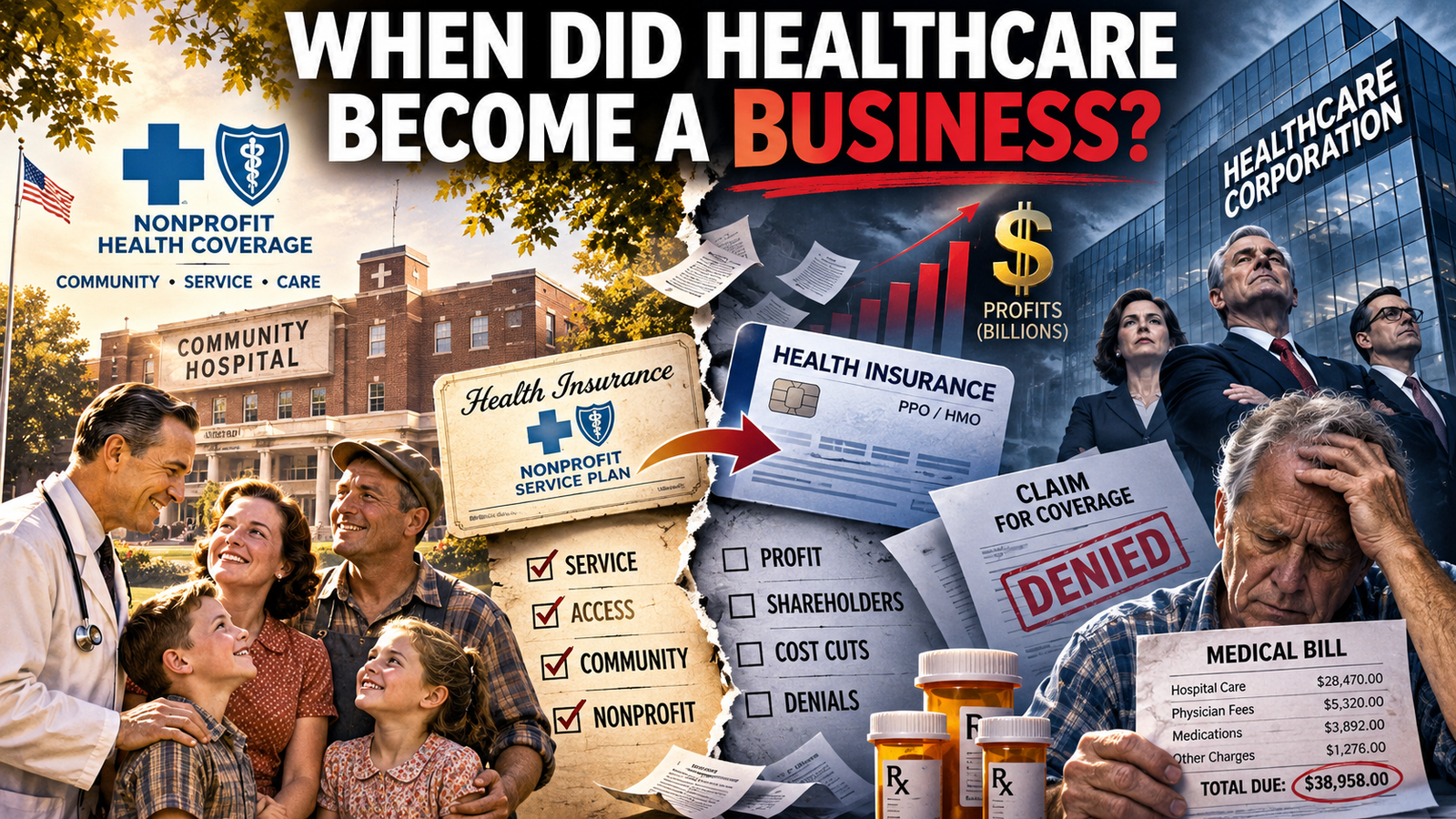
Here's a little American history that I think every citizen ought to understand. Especially those of us who have spent a lifetime paying health insurance premiums, deductibles, copays, and watching insurance companies find increasingly creative ways to tell us they aren't going to pay for something our doctors say we need.
There was a time when nonprofit organizations were at the heart of American health insurance. And two names you probably recognize were leading the way: Blue Cross and Blue Shield.
Let's go back to 1929.
Blue Cross began in Dallas, Texas, when Baylor University Hospital developed a prepaid hospital insurance arrangement for teachers. People paid a modest amount regularly, and in return they had protection against the potentially devastating cost of hospitalization.
The idea wasn't particularly complicated. Pool people's money, spread the risk, and make healthcare more affordable and accessible.
Blue Shield followed in the 1930s, developing coverage for physician services. The two organizations eventually became major forces in American health insurance. They were largely nonprofit institutions, designed around providing coverage rather than generating returns for outside shareholders.
Now, let's be clear: America never had an entirely nonprofit health insurance system. Commercial insurance companies existed decades before 1973. But nonprofit organizations played an enormous role in building the system millions of Americans relied upon.
Then came the 1970s, and the American healthcare business began changing.
In 1973, Republican President Richard Nixon signed the Health Maintenance Organization Act. This legislation encouraged the expansion of HMOs through federal support and incentives. It helped accelerate a transition toward managed-care organizations, including commercial, for-profit competitors.
It did NOT suddenly make for-profit health insurance legal. Those companies already existed. But it was an important part of the larger transformation that would reshape American healthcare.
During the 1980s and 1990s, the commercial insurance industry expanded dramatically. Some Blue Cross and Blue Shield organizations eventually converted from nonprofit to for-profit operations. Others remained nonprofit. The original federation of community-oriented insurance organizations became a much more complicated collection of independent companies with different ownership structures and financial incentives.
AND HERE'S SOMETHING THAT MIGHT SURPRISE YOU. EVEN THE NONPROFIT BLUE CROSS AND BLUE SHIELD WORLD HAS SOME EXTRAORDINARY EXECUTIVE COMPENSATION.
Let's look at the actual numbers.
Blue Shield of California, a nonprofit organization, reported that its CEO, Paul Markovich, received total compensation of $11.19 MILLION in 2024. That included a $1.52 million base salary and substantial performance incentives.
Blue Cross and Blue Shield of Minnesota, also a nonprofit, paid CEO Dana Erickson approximately $4.3 MILLION in 2024. Her compensation included a $2.6 million bonus.
And the national Blue Cross Blue Shield Association reported CEO Kim Keck's compensation at approximately $8.4 MILLION when including other reported compensation in its 2024 tax filing.
Let that sink in.
These are nonprofit organizations. Nonprofit does not mean they cannot generate operating surpluses, accumulate reserves, or pay executives substantial salaries and bonuses. It means they do not distribute profits to shareholders.
And that's an important distinction.
The problem isn't simply whether an insurance company is nonprofit or for-profit. The larger question is whether its financial incentives, executive compensation, and business practices are aligned with the interests of the people who depend on it for healthcare.
Now, let's look at the bigger picture.
Today, Americans spend more on healthcare than virtually any other developed nation. We have people rationing medications, postponing procedures, going bankrupt over medical bills, and losing sleep wondering whether an insurance company will approve treatment.
Meanwhile, insurance corporations generate billions in profits, executives receive extraordinary compensation, and shareholders expect their returns.
WHEN DID THE HEALTHCARE OF THE AMERICAN PEOPLE BECOME SECONDARY TO THE FINANCIAL INTERESTS OF THE HEALTHCARE INDUSTRY?
And before somebody jumps into the comments with the usual talking points, let me make something perfectly clear. Doctors deserve to be paid. Nurses deserve to be paid. Hospitals have operating expenses. Pharmaceutical research costs money. Nobody is suggesting otherwise.
But there is a tremendous difference between paying people for providing healthcare and building an enormous financial industry around denying, delaying, and extracting money from people who need it.
Healthcare is not a luxury automobile. It isn't a new television. It isn't a vacation package. You don't get to schedule your cancer, your heart attack, or your child's emergency appendectomy around your checking account balance.
I believe America can build a better system. I believe we can cover every American, compensate healthcare professionals fairly, encourage medical innovation, and stop allowing corporate financial interests to dominate decisions about people's lives.
Other developed nations have figured out ways to do this. Why are we still pretending it is impossible?
WE ARE THE WEALTHIEST NATION ON EARTH. WE HAVE THE TECHNOLOGY, THE TALENT, THE MEDICAL EXPERTISE, AND THE FINANCIAL RESOURCES. WHAT WE NEED IS THE POLITICAL WILL.
And perhaps the most important question of all:
If nonprofit health insurance organizations could serve millions of Americans for generations, why have we allowed ourselves to believe that putting financial interests ahead of patients is simply the price of doing business?
I don't buy it.
And neither should you.
— Leeboy 🇺🇸