
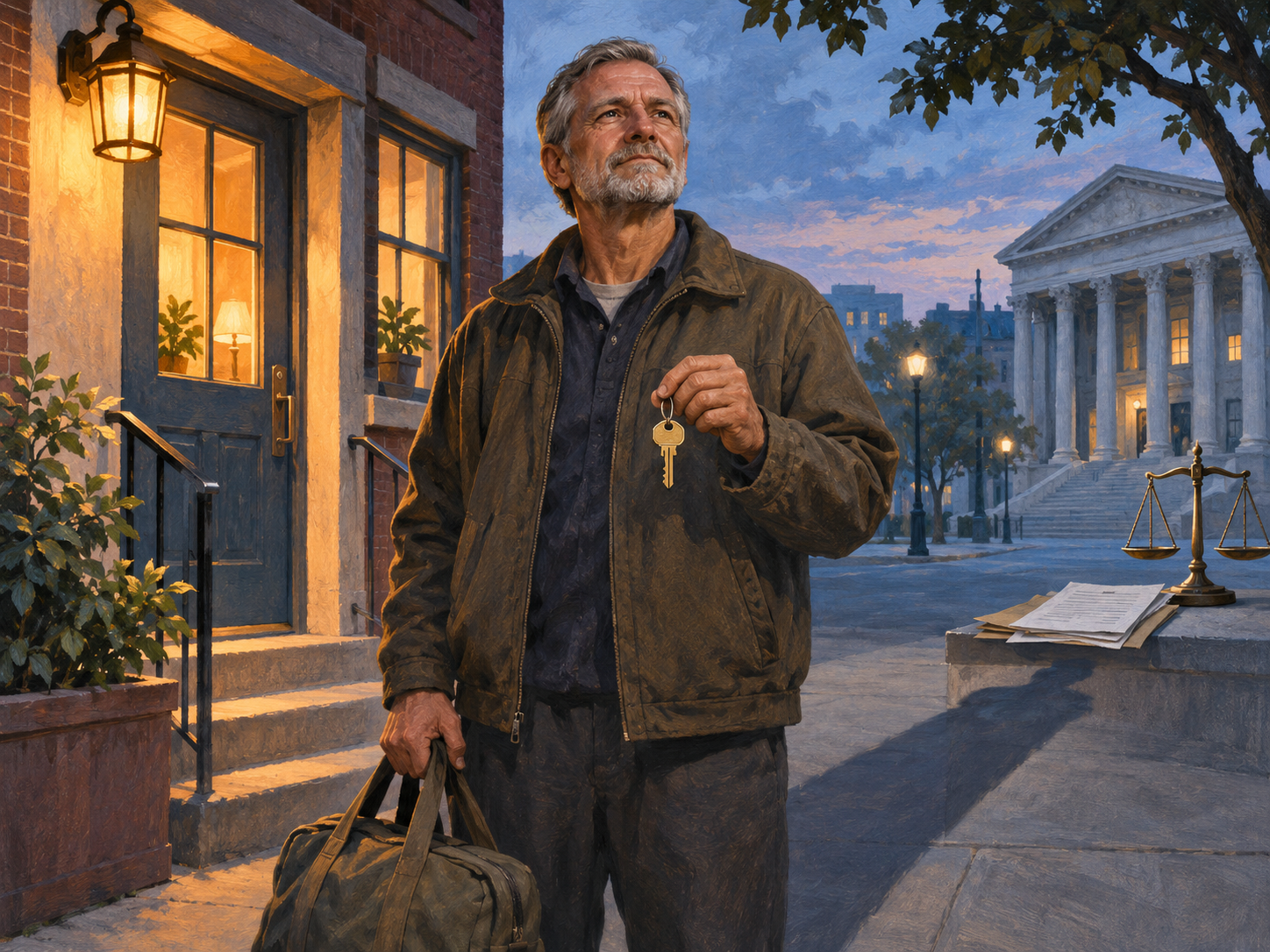
JUST WHEN YOU THINK THIS ADMINISTRATION HAS REACHED THE ABSOLUTE BOTTOM OF THE BARREL, SOMEBODY IN THE WHITE HOUSE SHOWS UP WITH A SHOVEL!
It's Veterans Day, America! That wonderful occasion when politicians wrap themselves in the American flag, deliver their carefully rehearsed speeches about honoring our heroes, and tell us how deeply they appreciate the sacrifices made by the men and women who served this country.
And what has the Trump administration been working on?
Well, apparently, helping homeless veterans by creating a government mechanism that could ultimately take away their ability to make decisions about their own lives.
WELCOME TO PROJECT SAFE HARBOR!
Doesn't that sound comforting? Safe Harbor. Almost makes you picture a cozy little seaside village, warm blankets, and somebody handing out hot coffee.
Except the actual program involves government-initiated guardianship proceedings, with internal planning documents envisioning expansion from hospitalized veterans to those experiencing homelessness on the streets.
And guardianship can mean surrendering control over where you live, how your money is managed, and who makes important decisions about your medical care.
NOT EXACTLY THE GI BILL, IS IT?
THE PRESIDENT WHO WANTS TO RESTORE ORDER—ONE HOMELESS PERSON AT A TIME
On July 24, 2025, Donald Trump signed Executive Order 14321, titled Ending Crime and Disorder on America's Streets.
Now, pay close attention to that title.
Apparently, in Donald Trump's America, homelessness isn't principally a humanitarian crisis. It's a public-order problem.
Imagine that! A country with unimaginable wealth, enormous medical resources, and some of the finest universities on the planet has people sleeping beneath bridges—and the administration's answer is to emphasize getting them off the streets through policing and institutional treatment.
The executive order encourages stronger enforcement of laws against public camping and loitering. It also directs federal officials to pursue broader civil commitment standards for certain people with serious mental illnesses.
To be precise, Trump did not single-handedly make homelessness a federal crime. But his administration has explicitly encouraged policies that can penalize conduct associated with having nowhere to live.
WHAT A BRILLIANT CONCEPT!
Can't afford an apartment? Let's make sleeping outside harder.
Need mental health services? Perhaps the government should decide where you belong.
Can't find affordable housing? Well, congratulations! Your problems have apparently been promoted from the Department of Housing and Urban Development to the law-enforcement community.
One might reasonably ask whether anybody in this administration has considered the radical possibility of addressing homelessness by helping people obtain HOMES.
I know. Revolutionary thinking.
THEN CAME PROJECT SAFE HARBOR
The Department of Veterans Affairs developed Project Safe Harbor, a guardianship pilot whose internal planning documents were subsequently introduced into the congressional record.
The project was designed to begin at five VA locations and expand through a series of stages.
Initially, the focus was on veterans already receiving hospital care who lacked the capacity to make important decisions and had no appropriate legal representative.
Now, let's be fair. There absolutely are veterans who suffer serious cognitive impairments or medical conditions and genuinely need assistance making decisions. Providing those people with appropriate care and legal safeguards is a legitimate government responsibility.
BUT THAT'S NOT WHERE THE PLANNING DOCUMENTS STOPPED.
The VA's own materials described later stages extending the guardianship model to veterans experiencing sheltered or unsheltered homelessness—including people outside existing VA programs.
Think about that for a moment.
The government begins by describing a narrowly focused program for incapacitated hospital patients.
Then its internal documents envision expanding the same model to people living on the streets.
That is not a trivial distinction.
And no, being homeless does not automatically mean a person is mentally incompetent. The VA's planning documents also refer to assessing decision-making capacity, but the proposed expansion raises an obvious concern: How rigorously would that distinction be protected?
Poverty is not a psychiatric diagnosis.
Living in your automobile is not evidence that you're incapable of making decisions.
Sleeping beneath a highway overpass does not mean you have forfeited your constitutional rights.
AND SERVING YOUR COUNTRY CERTAINLY SHOULD NOT MAKE YOU A CANDIDATE FOR LOSING CONTROL OVER YOUR OWN LIFE.
THEN CONGRESS STARTED ASKING QUESTIONS. HOW INCONVENIENT!
On March 18, 2026, Dr. Thomas O'Toole of the Department of Veterans Affairs appeared before the House Veterans' Affairs Committee.
He described an initiative focused on approximately 700 hospitalized veterans who could not make medical decisions for themselves and lacked appropriate representation.
According to his testimony, the initiative was not intended as a homeless-outreach program.
Well, there's just one little problem.
THE VA'S OWN PLANNING DOCUMENTS DESCRIBED A MUCH BROADER PROGRAM!
Representative Mark Takano and other members of Congress examined the internal records, which outlined possible expansion to veterans experiencing homelessness outside hospitals.
And on March 25, organizations representing homeless veterans submitted testimony raising alarms about precisely that issue.
Now, I'm not going to declare that O'Toole knowingly lied under oath. Proving that requires establishing what he knew, when he knew it, and whether the earlier plans had formally changed.
But I will say this:
WHEN YOUR OFFICIAL EXPLANATION TO CONGRESS DOESN'T MATCH YOUR OWN AGENCY'S PLANNING DOCUMENTS, YOU HAVE SOME EXPLAINING TO DO!
Congress is entitled to know which version represents actual policy.
The administration cannot simply wave away internal government documents and expect everyone to applaud its transparency.
And if the broader proposal really was abandoned, producing the revised documents should be a relatively straightforward exercise.
Yet by June, Takano was publicly complaining that the VA still had not adequately clarified the program.
Apparently, transparency is another one of those expensive government services this administration is determined to cut.
ENTER PAM BONDI AND THE DEPARTMENT OF JUSTICE
Here's where this gets even more interesting.
On March 11, 2026, the Department of Veterans Affairs and the Department of Justice signed a memorandum of understanding.
The agreement permits DOJ to appoint VA attorneys as special assistant United States attorneys, giving them authority to initiate or participate in certain state-court guardianship proceedings.
The administration says the objective is to help vulnerable veterans who cannot make their own healthcare decisions.
And in genuinely appropriate cases, legal guardianship can serve a legitimate and important purpose.
But the arrangement also provides a mechanism through which government attorneys can seek to transfer decision-making authority away from veterans.
That makes judicial safeguards, independent medical assessments, and clear limitations on the program absolutely essential.
Veterans' advocates aren't imagining the danger.
Organizations including Iraq and Afghanistan Veterans of America and the American Civil Liberties Union have warned that expanding guardianship as a response to homelessness could threaten veterans' civil liberties and discourage them from seeking help.
Imagine being a struggling veteran who desperately needs treatment but begins worrying that contacting the VA could eventually lead to a court proceeding over your independence.
WHAT A WONDERFUL WAY TO ENCOURAGE VETERANS TO TRUST THEIR GOVERNMENT!
LET'S TALK ABOUT FREEDOM FOR A MINUTE
Republicans certainly enjoy talking about freedom.
Freedom this. Liberty that. Constitutional rights. Government overreach. Individual responsibility.
You know the routine.
But when it comes to people experiencing homelessness, suddenly some of those principles seem remarkably flexible.
Here's the question I want every American to consider:
HOW DO WE HONOR PEOPLE WHO FOUGHT FOR OUR FREEDOM WHILE ADVANCING A PROGRAM THAT COULD PLACE THEIR OWN FREEDOM AT RISK?
A guardianship proceeding is not some harmless bureaucratic exercise.
Depending on the court order and applicable state law, guardianship can affect fundamental decisions about medical care, finances, relationships, and where someone lives.
And these arrangements can be extraordinarily difficult to reverse.
Now combine that with an administration openly encouraging expanded institutional treatment as a response to homelessness.
Does anybody seriously believe Congress should simply shrug and take the administration's word that everything will be fine?
GOOD GRIEF!
This is precisely why we have congressional oversight.
It's why government records matter.
It's why independent courts matter.
And it's why constitutional protections cannot depend on whether the person needing them happens to have a roof over their head.
HERE'S AN IDEA: TRY SOLVING THE ACTUAL PROBLEM!
What homeless veterans need is not particularly mysterious.
They need affordable housing.
They need accessible healthcare.
They need effective mental health and substance-use treatment when appropriate.
They need assistance navigating disability benefits and employment opportunities.
They need sustained support that helps them regain stability, independence, and dignity.
And when a veteran genuinely lacks decision-making capacity, they need individualized protection that preserves as much autonomy as possible.
The VA itself reports that more than 51,000 veterans were permanently housed during fiscal year 2025.
Think about that.
We already have programs capable of helping veterans move into permanent housing.
Why wouldn't expanding access to successful housing and support services be the centerpiece of the national strategy?
BECAUSE APPARENTLY FINDING PEOPLE A PLACE TO LIVE ISN'T NEARLY AS EXCITING AS ANNOUNCING ANOTHER LAW-AND-ORDER CRUSADE!
THE FAILURE ISN'T JUST THE POLICY. IT'S THE PRIORITIES.
This administration loves grand announcements, dramatic executive orders, tough-guy rhetoric, and the appearance of decisive action.
But governing requires something more difficult than giving a speech or signing another document in front of the cameras.
It requires understanding the underlying problem.
Homelessness is not solved by pretending that everyone sleeping outdoors is dangerous, addicted, or mentally incapable.
Nor is it solved by substituting government control for affordable housing.
And it certainly isn't solved by developing a potentially sweeping program, describing it narrowly to Congress, and then failing to provide adequate answers when lawmakers discover the broader planning documents.
If Project Safe Harbor is now limited strictly to appropriate guardianship cases involving incapacitated hospitalized veterans, then release the current program charter.
Publish the eligibility criteria.
Disclose how many cases have been initiated.
Explain what happened to the earlier plans for expanding into the homeless population.
And demonstrate how every veteran's legal rights will be protected.
THAT'S CALLED ACCOUNTABILITY. SOMETHING THIS ADMINISTRATION SEEMS TO FIND ABOUT AS WELCOME AS A SUBPOENA.
ON THIS VETERANS DAY, AMERICA DESERVES SOME ANSWERS
Donald Trump has spent years portraying himself as the ultimate champion of America's veterans.
Wonderful.
Then let's measure that commitment by more than speeches, slogans, and patriotic decorations.
Let's measure it by whether veterans have homes.
Whether they can obtain medical treatment.
Whether their benefits are accessible.
Whether their constitutional rights are respected.
And whether the government treats them as citizens deserving dignity rather than administrative problems requiring containment.
We do not yet have proof that Project Safe Harbor has been used to systematically institutionalize homeless veterans against their will.
But we do have an executive order encouraging broader civil commitment, internal VA documents envisioning an expanded guardianship model, a formal VA-DOJ agreement, and serious unresolved questions raised by veterans' advocates and members of Congress.
THAT IS MORE THAN ENOUGH TO JUSTIFY AGGRESSIVE CONGRESSIONAL OVERSIGHT.
And it is more than enough to demand that the administration explain precisely what it intends to do.
Because here's the bottom line:
A VETERAN WHO FOUGHT FOR THIS COUNTRY AND NOW FINDS HIMSELF SLEEPING UNDER A BRIDGE HAS NOT FAILED AMERICA.
AMERICA HAS FAILED HIM.
And the very last thing that veteran needs is a government more interested in making him disappear from public view than helping him rebuild his life.
So Happy Veterans Day, Mr. President.
Perhaps next year we can celebrate by ensuring that more of America's veterans have a home to sleep in—and that those who need help can obtain it without fearing for their independence.
NOW THERE'S A CONCEPT WORTH PUTTING ON A RED HAT.
— J. Lee Murphy
---
SOURCES AND DOCUMENTATION
1. Executive Order 14321 — Ending Crime and Disorder on America's Streets, July 24, 2025
2. House Veterans' Affairs Committee — March 18, 2026 hearing and Project Safe Harbor documents
3. Congressional hearing record — March 25, 2026, including testimony from veterans' and civil-liberties organizations
4. Department of Justice — VA and DOJ guardianship agreement, March 11, 2026
5. Department of Veterans Affairs — Official explanation of the guardianship agreement
6. NPR — Trump's institutionalization initiative and concerns about homeless veterans, June 25, 2026