
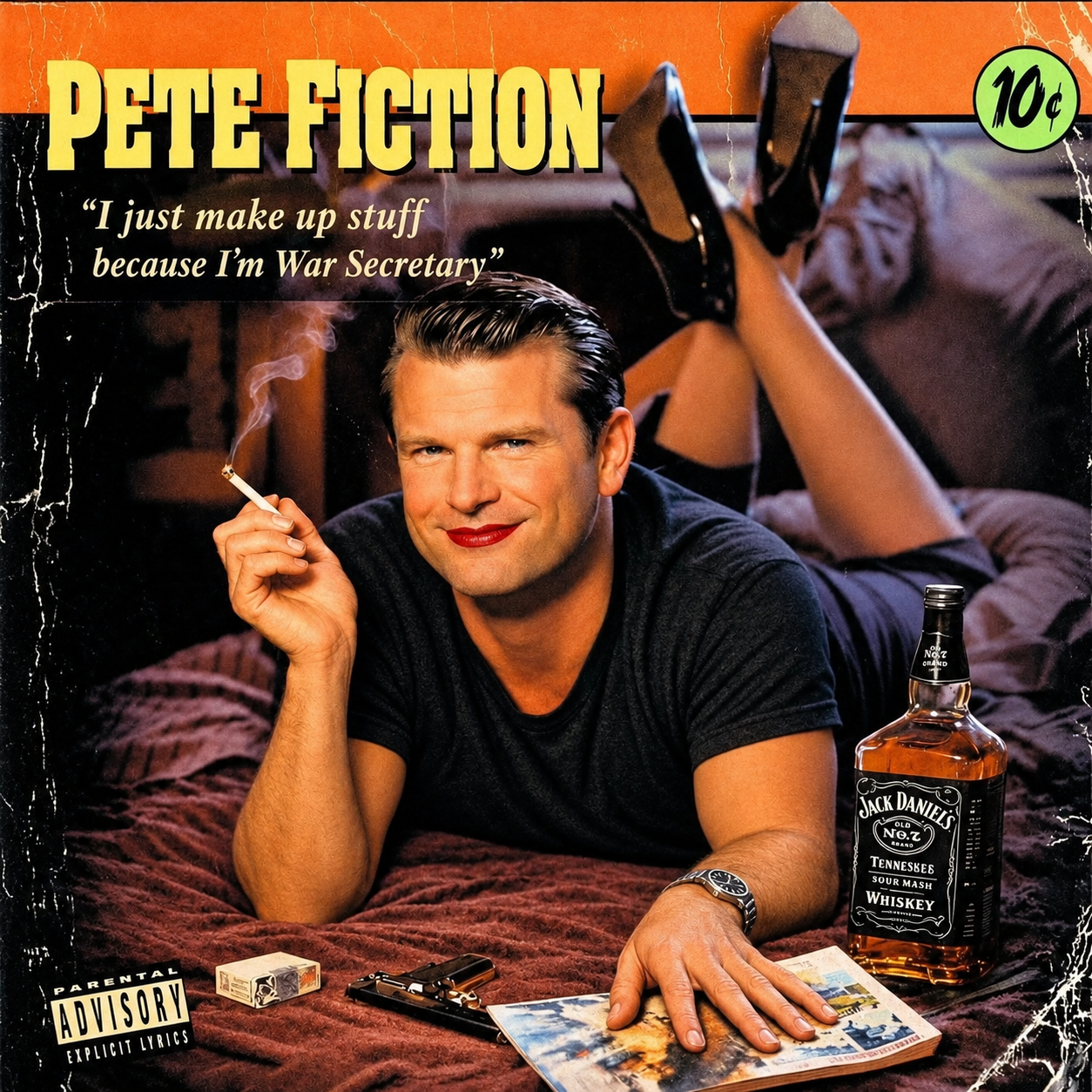
Pete Hegseth has become one of the public faces of the Iran war—and now the war is looking less like the quick win its boosters promised and more like a bill coming due. President Trump made the decision to go to war, so the blame doesn’t belong to Hegseth alone. But Hegseth was one of the administration’s most vocal champions, and reporting says Trump has begun asking allies about his performance. That is not a comfortable place to be in this White House. The Atlantic reported on Trump’s questions about Hegseth’s role. The image is satire too; the quote printed on its cover is invented.
Then there’s the Pentagon purge. Hegseth has fired or pushed out senior officers, including Army Chief of Staff Randy George and, most recently, Lt. Gen. Brett Sylvia, a 32-year Army veteran. The Pentagon hasn’t publicly explained many of these departures. You don’t steady a military by making experienced commanders wonder who’s next—or by treating a long record of service as a political inconvenience. The Washington Post reported on Sylvia’s removal.
I should be precise about one thing: Hegseth did serve in Iraq and Afghanistan, and the Defense Department lists him as receiving the Combat Infantryman Badge. So “not a single day of combat” isn’t accurate. The fair criticism is that his experience as a former National Guard major is not the same as decades spent leading a service, a command, or the Pentagon. He can respect the people who have carried that responsibility—or keep showing the country how little he seems to value their experience. The Defense Department biography lists his deployments and awards.
And the testosterone fixation? Hegseth announced mandatory testosterone-deficiency screening for service members 30 and older, branding the initiative “The High-T Department of War.” The Pentagon later temporarily rescinded its clinical guidelines while revising them. When the secretary is spending this much attention on hormone levels and a chest-thumping idea of military toughness, people are entitled to ask whether this is serious readiness policy or another performance for the cameras. CBS News reported on the screening policy and its temporary rescission.
That’s why I think Hegseth could be gone quickly: an unpopular war, a growing fight over the generals he has pushed out, and a president who may decide he needs somebody else to answer for the mess. Maybe Trump keeps him. Maybe he needs a fall guy. Either way, Hegseth has made himself central to a war whose outcome he cannot simply declare into a victory. The clock is ticking—and the country shouldn’t have to wait for another round of damage to find out whether he can do the job.